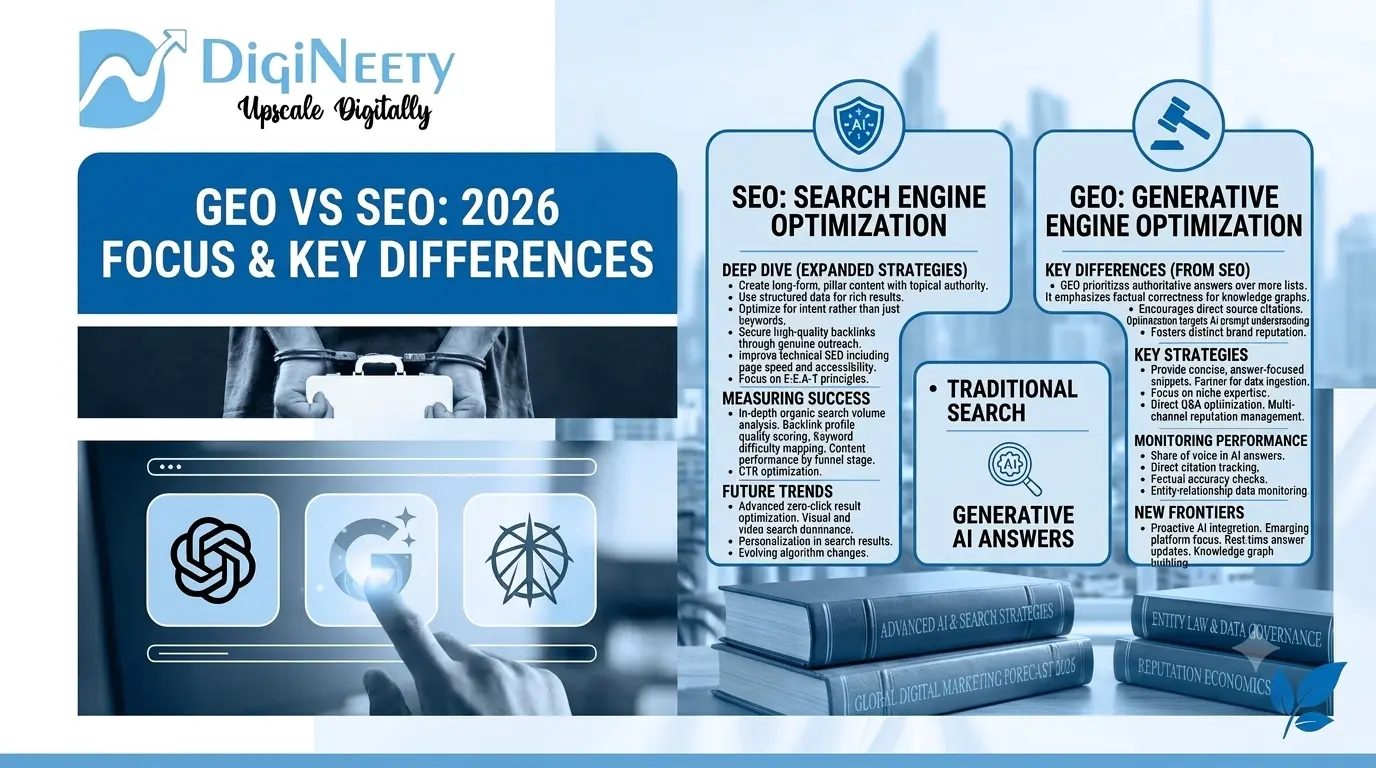
GEO vs SEO: Which Marketing Strategy Should Your Business Focus on in 2026?
Overview Summary: GEO (Generative Engine Optimization) and SEO (Search Engine Optimization) are not competing strategies — they’re two layers of the same visibility stack. SEO gets you ranked on Google and Bing; GEO gets you cited inside ChatGPT, Gemini, Perplexity, and Google’s AI Overviews. In 2026, businesses that treat them as complementary — rather than picking one — are the ones capturing both clicks and AI-driven brand authority. This guide breaks down the real differences, when to prioritize each, and how to build an integrated strategy for your business.
If you’ve been in a marketing meeting anytime in the last year, you’ve probably heard someone ask: “Is SEO dead? Should we be doing GEO instead?”
It’s a fair question. Search behavior has genuinely changed. People now ask ChatGPT for product recommendations, get instant summaries from Google’s AI Overviews without clicking a single link, and use Perplexity the way they used to use Google. But the answer isn’t “switch from SEO to GEO.” The answer is that your business now needs both — and understanding exactly how they differ is what determines whether you invest your budget correctly in 2026.
At Digineety, we work with businesses across Mumbai and beyond to build exactly this kind of integrated visibility strategy, so let’s break down what’s actually changing and what to do about it.
What is SEO?
Search Engine Optimization is the practice you already know: optimizing your website so it ranks higher in traditional search engine results pages (SERPs) on Google and Bing. The goal is simple — rank well, earn the click, bring the visitor to your site, and convert them there.
SEO relies on a well-established set of levers: keyword targeting, backlinks, technical site health, page speed, internal linking, meta tags, and content depth. It’s measured through rankings, organic traffic, and click-through rate (CTR). If your website’s foundation — site structure, page speed, on-page optimization — isn’t solid yet, that’s the place to start; our SEO services are built around exactly this groundwork.
What is GEO?
Generative Engine Optimization is the practice of structuring your content and brand presence so that AI systems — ChatGPT, Gemini, Claude, Perplexity, and Google’s AI Overviews — cite, quote, or recommend you when generating an answer to a user’s question.
The fundamental difference: GEO isn’t chasing a click. It’s chasing a mention. When someone asks an AI assistant “what’s the best CRM for a small real estate agency,” GEO is what determines whether your brand’s name shows up inside that generated answer at all.
This matters because generative engines don’t operate like traditional search. They don’t return ten blue links for a user to click through — they synthesize one direct answer from multiple sources, and if your content isn’t structured to be understood, trusted, and “extractable,” it simply won’t be pulled into that response. This is the core of what our GEO marketing services focus on: making your brand a source AI systems trust enough to cite.
Closely related to GEO is LLM marketing — optimizing specifically for how large language models like ChatGPT interpret, trust, and reuse your content. We’ve covered this in detail in our guide to LLM marketing for Mumbai businesses, which is worth a read if you want to go deeper on the AI-platform side of this strategy.
GEO vs SEO: The Core Differences
| Factor | SEO | GEO |
| Goal | Rank high, earn the click | Get cited or recommended in AI-generated answers |
| Success metric | Rankings, organic traffic, CTR | Brand mentions, citation frequency, share of voice in AI answers |
| Platforms targeted | Google, Bing SERPs | ChatGPT, Gemini, Perplexity, Copilot, Google AI Overviews |
| Content approach | Keyword-optimized, comprehensive pages | Clear, structured, self-contained, fact-based answers |
| Where content lives | Primarily your own website | Your website and third-party platforms AI engines pull from (forums, reviews, PR, Reddit, LinkedIn, YouTube transcripts) |
| User outcome | Visitor clicks through to your site | User gets the answer without visiting your site — but arrives more “sold” if they do click |
The distinction that trips most marketers up: in SEO, ranking your own domain is the whole game. In GEO, your job is to make sure your expertise shows up wherever an AI model might be pulling its information from — which often has nothing to do with your website at all.
Does GEO Replace SEO? No — Here’s Why
This is the part every credible source agrees on: GEO is not a replacement for SEO, it’s an evolution built on top of it. A large share of AI Overview citations still come from content that already ranks well organically — which means strong SEO fundamentals (authority, structure, E-E-A-T signals) are still doing heavy lifting for GEO performance behind the scenes.
Think of it as a three-layer stack:
- SEO builds your baseline visibility and authority across traditional search.
- AEO (Answer Engine Optimization) makes sure your content is structured to win featured snippets and AI Overview boxes.
- GEO extends that authority into full generative answers across LLMs, where your brand gets referenced even when there’s no click at all.
Skip SEO, and GEO has no foundation to stand on. Skip GEO, and you become invisible in a growing share of searches that never reach a traditional results page in the first place. Businesses that want both layers covered under one roof often look at an AIO (AI Optimization) marketing approach, which is designed to bridge exactly this gap.
Why 2026 Is the Tipping Point
A few shifts are forcing this conversation right now:
- Zero-click search is the norm, not the exception. A large and growing share of Google searches now end without any click at all, as AI Overviews answer the query directly on the results page.
- People are starting their research journey inside AI tools, not Google — then sometimes finishing it on Google, and sometimes not touching a search engine at all.
- Conversion quality from GEO-driven traffic tends to be higher. Visitors who do click through from an AI-generated recommendation typically arrive further along in their decision-making, because the AI has already done part of the convincing for them.
- Google itself still dominates total search volume by a wide margin — so this isn’t about abandoning traditional search. It’s about not leaving an entire emerging channel unclaimed while your competitors get there first.
Which One Should Your Business Focus On?
Here’s the honest, non-generic answer: it depends on where you are today, not on which acronym sounds newer.
Prioritize SEO first if:
- You don’t yet have solid organic rankings or technical site health
- Your website has thin content, weak internal linking, or unresolved technical issues
- Your industry’s buyers still search primarily on Google (many local, transactional, and high-intent categories still do)
Invest meaningfully in GEO alongside SEO if:
- You’re already ranking reasonably well and want to protect visibility as zero-click search grows
- Your audience researches complex or comparison-heavy decisions (B2B software, financial products, real estate, healthcare) — these are exactly the queries people now take to ChatGPT and Perplexity
- Competitors in your space are starting to show up in AI-generated answers and you aren’t
Realistically, for most growing businesses in 2026, the answer is not “either/or” — it’s building one integrated content strategy that serves both. The same page can be written to rank on Google and be structured so an AI model can lift a clean, quotable answer from it.
How to Build an Integrated SEO + GEO Strategy
- Keep your technical SEO and E-E-A-T foundation strong. Authoritative, well-structured, fast-loading, mobile-friendly sites remain the baseline both search engines and AI models trust.
- Structure content for extraction, not just ranking. Use clear H2/H3 headers, put direct answers early in each section, and write self-contained paragraphs that make sense without the surrounding context — that’s exactly what AI systems pull from.
- Add comparison tables, FAQs, and schema markup. These formats are disproportionately favored by both Google’s AI Overviews and LLM citation engines.
- Build your presence beyond your own website. Get mentioned in industry forums, contribute to LinkedIn and Reddit discussions, pursue digital PR, and publish on platforms like Medium — AI engines synthesize answers from across the web, not just your domain. This kind of authority-building sits at the core of our GEO marketing and branding & identity work.
- Track new KPIs. Traffic and rankings alone won’t tell the full story anymore. Start monitoring brand mentions across AI platforms, citation frequency, and share of voice in generative answers, alongside your usual organic metrics — our performance analytics service is built to track exactly this combined view.
- Write like a human, for humans — and let the structure do the AI-optimization work. Content that reads as genuinely helpful, specific, and honest performs better with both audiences than content optimized purely for keywords or engineered for citations.
The Bottom Line
SEO and GEO aren’t rivals fighting for your marketing budget — they’re two halves of the same visibility strategy, built for a search landscape where your customers now discover you through blue links and AI-generated conversations. The businesses that win in 2026 won’t be the ones who picked a side. They’ll be the ones who built content ecosystems strong enough to serve both.
If you’re not sure whether your current content is optimized for either — let alone both — that’s usually the first gap worth closing.
FAQs
Is GEO replacing SEO in 2026? No. GEO builds on top of SEO fundamentals — strong SEO signals like authority and structure still influence whether AI engines trust and cite your content.
What’s the difference between GEO and LLM marketing? They overlap heavily. GEO is the broader discipline of optimizing for AI-generated answers across all generative engines; LLM marketing specifically focuses on optimizing for how large language models like ChatGPT interpret and cite your brand.
Should a small business invest in GEO right now? If your buyers research comparison-heavy or high-consideration purchases, yes — these are exactly the queries increasingly being asked to AI tools instead of Google.
How do I measure GEO success? Track brand mentions across AI platforms, citation frequency in AI-generated answers, and share of voice — not just rankings and organic traffic.
Want a clear picture of where your brand stands across both traditional rankings and AI-generated answers? Get in touch with the Digineety team for a free SEO + AI visibility audit.

Pingback: Local SEO Strategies That Help Mumbai Businesses Rank Higher - Digineety