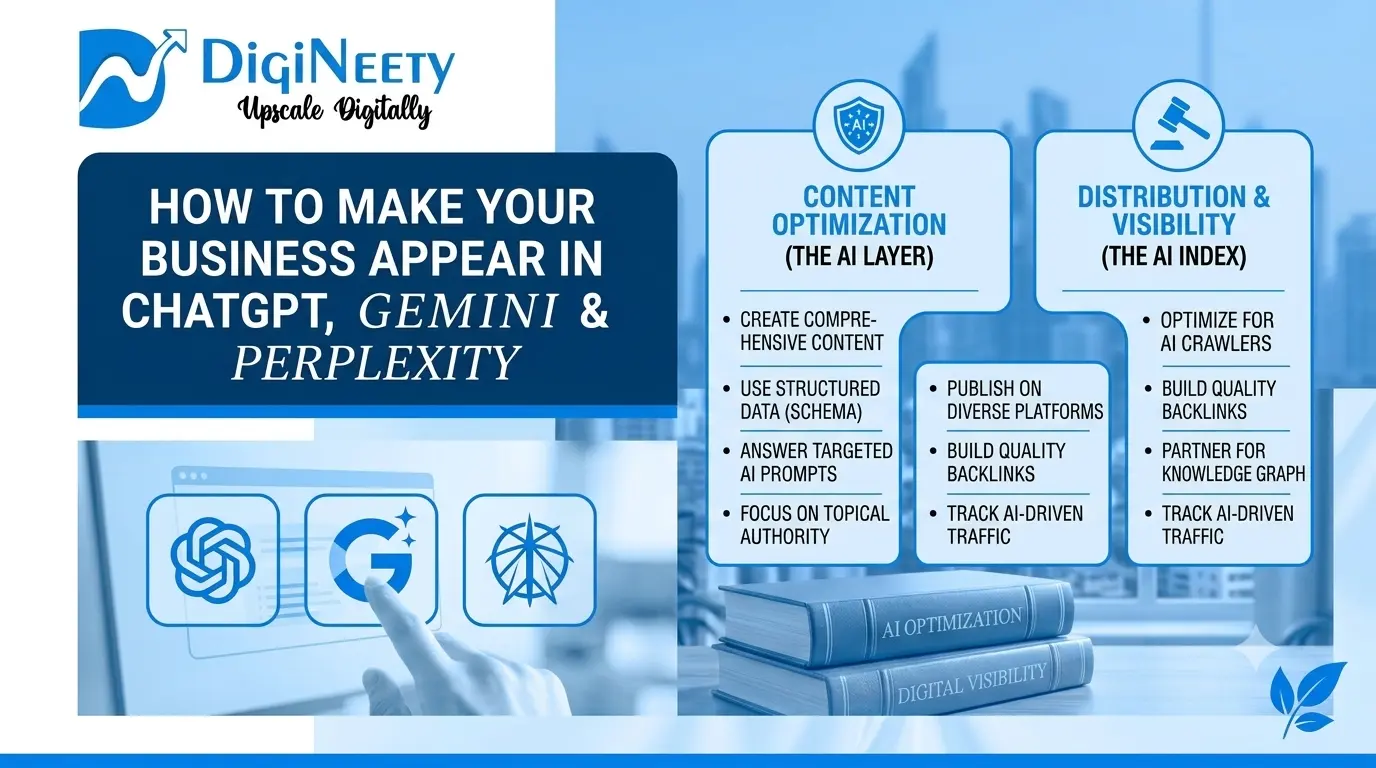
How to Make Your Business Appear in ChatGPT, Gemini & Perplexity
Overview Summary: To appear in ChatGPT, Gemini, and Perplexity answers, businesses need three things working together: technical accessibility (allowing AI crawlers, adding an llms.txt file), content structured for extraction (answer-first paragraphs, clear headings, comparison tables, FAQ schema), and third-party authority (digital PR, consistent brand mentions, and strong entity signals like Google Business Profile and Wikidata). Each platform pulls from different sources — Bing for ChatGPT, live web crawling for Perplexity, and Google’s own ecosystem for Gemini — so a single generic strategy won’t work equally well across all three. This guide breaks down exactly what to do for each platform and how to build it into an ongoing process rather than a one-time fix.
A growing share of your potential customers are no longer typing questions into Google. They’re asking ChatGPT, Perplexity, and Gemini directly — and instead of getting ten blue links to compare, they get one synthesized answer with a handful of sources cited. If your business isn’t one of those sources, you don’t just rank lower. You don’t exist in that conversation at all.
We covered the strategic difference between traditional rankings and AI citations in our earlier piece on GEO vs SEO in 2026. This guide goes a level deeper — the actual, practical steps to get your business showing up inside ChatGPT, Gemini, and Perplexity answers.
Why This Matters Right Now
AI platforms have moved from experimental to mainstream far faster than most marketing teams have adjusted for. A large and growing share of buyers — across both B2B and consumer categories — now use an AI tool at some point during their research, and many start there instead of Google. Visitors who arrive at your website after being cited in an AI answer also tend to convert noticeably better than typical organic traffic, because the AI has already done part of the convincing before they ever click through.
The catch: each platform decides who gets cited through a different mechanism. Treating “AI search” as one single channel and applying one generic strategy across all three is one of the most common — and costly — mistakes businesses make. Let’s break down each one.
How ChatGPT Chooses What to Cite
ChatGPT’s live web retrieval runs through Bing, not Google. That single fact changes your entire approach:
- Rank in Bing, not just Google. If your site is barely indexed on Bing, you’re cutting yourself out of a large share of ChatGPT’s citation pool regardless of how well you rank on Google.
- Make sure GPTBot and OAI-SearchBot aren’t blocked in your robots.txt. It’s a surprisingly common and easily fixed technical oversight.
- Publish original research and data. ChatGPT tends to favor citing content built on original statistics, surveys, or case studies over content that simply repackages what’s already out there.
- Get quoted in media coverage. Being directly quoted in a news article or industry publication increases the odds that content chain eventually surfaces in a ChatGPT answer.
How Perplexity Chooses What to Cite
Perplexity is the most transparent of the three — it shows its sources directly, with clickable links, right inside the answer. That transparency also means it’s the easiest platform to test and measure your current visibility on.
- Freshness matters more here than anywhere else. Perplexity crawls and updates far more frequently than the training cycles behind ChatGPT or Gemini, so recently published or recently refreshed content has a real edge.
- Factual density wins. Sourced statistics, specific dates, and precise figures are what Perplexity’s retrieval tends to favor over vague, generic statements.
- High-authority domains still carry weight — news sites, industry publications, and review platforms are disproportionately represented in Perplexity’s citations.
- Because of how quickly it updates, Perplexity is also the best platform to run your first manual visibility tests on (more on that below).
How Gemini Chooses What to Cite
Gemini is the one platform where your existing SEO and local presence directly carries over, because Gemini is deeply woven into the Google ecosystem — Search, Knowledge Graph, Google Business Profile, Search Console, and YouTube all feed into it.
- If you already rank well on Google, Gemini is far more likely to know and cite you. The two are closely linked in a way ChatGPT and Perplexity aren’t.
- A fully optimized Google Business Profile matters a lot, especially for local and location-specific queries.
- E-E-A-T signals carry heavy weight — author credentials, a detailed About page, professional certifications, and structured data all feed Gemini’s authority assessment.
- YouTube is an underused lever. A well-titled, well-described video can trigger cross-citations inside Gemini responses in a way most businesses aren’t taking advantage of yet.
The Technical Foundation: Make Sure AI Can Actually Read You
Before any content or PR strategy pays off, your site needs to be technically accessible to AI systems in the first place.
- Check your robots.txt. Confirm you’re allowing the crawlers you want citing you — GPTBot, OAI-SearchBot, ChatGPT-User, ClaudeBot, PerplexityBot, and Google-Extended are the main ones to review.
- Add an llms.txt file at your site’s root. This is a simple markdown file that points AI models toward your most authoritative pages — think of it as a sitemap written specifically for AI systems rather than search engine crawlers.
- Keep your site HTML-first and fast. Heavy JavaScript rendering that search and AI crawlers struggle to parse is one of the most overlooked reasons good content never gets cited.
- Use Schema.org markup, particularly FAQ, Article, and Organization schema — these give AI systems clean, structured signals about what your content is and who’s behind it.
If your website’s current technical health hasn’t been audited for this yet, this is exactly the kind of gap our SEO services and LLM marketing work is built to close.
Structure Your Content the Way AI Actually Reads It
AI systems don’t read your page top to bottom the way a human might. They pull specific, self-contained fragments — a paragraph, a table, a stat — and reassemble them into an answer. That means:
- Answer the core question in the first 100 words. If the opening of your page doesn’t deliver a complete, quotable answer, everything below it matters less than it should.
- Use comparison tables, named frameworks, and clear H2/H3 headers. These are consistently the formats AI systems extract most reliably, far more than long unstructured paragraphs.
- Add FAQ sections with schema markup. Direct question-and-answer formatting mirrors exactly how people phrase prompts to ChatGPT, Gemini, and Perplexity in the first place.
- Include real statistics, sourced data, and specific figures. Content backed by verifiable numbers earns meaningfully more AI visibility than content making the same claims without evidence.
- Refresh key pages regularly. A 60–90 day content refresh cycle keeps you in rotation, especially for Perplexity, which rewards freshness heavily.
Build the Third-Party Authority AI Systems Actually Trust
Here’s the part most businesses underinvest in: AI systems weigh brand mentions across the wider web far more heavily than they weigh your own website content alone. A consistent presence across independent, authoritative sources correlates far more strongly with AI visibility than backlinks ever did for traditional SEO.
- Pursue ongoing digital PR, not a one-time push. Aim for a steady drip — a few expert quotes in industry publications each month, a contributed article each quarter, and larger thought-leadership pieces annually.
- Build entity authority. A Google Business Profile, a Wikidata entry, and a Knowledge Panel (where achievable) all give AI systems a structured, verifiable identity to cite with confidence.
- Get listed in relevant industry directories and comparison guides. These are exactly the kind of “affinity” sources AI models cross-reference when building an answer.
- Stay consistent within your niche. A brand that repeatedly shares expert insight on the same one or two topics builds a far stronger association in AI systems than one that comments on everything. Repetition, not range, is what builds topical trust here.
- Keep your NAP (name, address, phone) consistent across every directory and platform — inconsistency is one of the quieter reasons AI systems lose confidence in a brand’s identity.
This kind of ongoing authority and brand-presence building is the core of what our GEO marketing and branding & identity services focus on — it’s rarely a one-off project, and it compounds the longer you stay consistent with it.
How to Test and Measure Your Current AI Visibility
You don’t need expensive tools to get started — a manual audit will tell you exactly where you stand today.
- Run 10–15 real buyer-style prompts across ChatGPT, Gemini, and Perplexity — the kind of questions your actual customers would ask (e.g., “best [your category] agency in Mumbai”).
- Note whether you’re mentioned, how accurately, and who else appears in the same answer. Watch for factual errors in how AI describes your business — these need correcting just as urgently as an absence.
- Check your analytics for AI-referral traffic. In Google Analytics 4, filter Acquisition by source for chatgpt.com, perplexity.ai, and gemini.google.com — this is a solid proxy for how often you’re actually being cited.
- Repeat this monthly. GEO is not a set-it-and-forget-it project. Track how your mention frequency, accuracy, and positioning relative to competitors shift over time, and let that data guide what you refresh or build next.
Our performance analytics service can help set this kind of ongoing AI visibility tracking up alongside your existing SEO reporting, so you’re watching both channels from one dashboard rather than two disconnected ones.
The Bottom Line
Getting cited by ChatGPT, Gemini, and Perplexity isn’t a single trick or a technical hack — it’s the combination of being technically accessible, structurally quotable, and consistently validated by sources outside your own website. None of these levers work in isolation, and none of them pay off overnight; most businesses see meaningful movement over a matter of months, not days, especially as it relates to ChatGPT’s slower training-driven updates.
The businesses treating this as an ongoing discipline — auditing monthly, refreshing content quarterly, and building real third-party authority year-round — are the ones that will be the default AI recommendation in their category well before their competitors even notice the shift happened.
FAQs
Which AI platform should I prioritize first? Perplexity is usually the best place to start testing, since it updates quickly and shows its sources transparently, so you can see results and course-correct within weeks rather than months.
Do I need to rank on Google to appear in ChatGPT or Perplexity? Not directly — but strong existing SEO helps across all three, and it’s essential for Gemini specifically, since Gemini draws heavily from Google’s own index and Knowledge Graph.
How long does it take to start appearing in AI answers? Perplexity can show changes within a few weeks. ChatGPT typically takes longer, since much of its knowledge is shaped by training cycles rather than live retrieval alone. Meaningful, durable AI visibility is generally a months-long, ongoing effort rather than a quick fix.
What’s the single highest-impact first step? Run the manual audit described above. You can’t fix an AI visibility gap you haven’t measured, and it takes less than an hour to get a clear baseline across all three platforms.
Want to know exactly where your brand currently stands across ChatGPT, Gemini, and Perplexity? Get in touch with the Digineety team for a free AI visibility audit.